
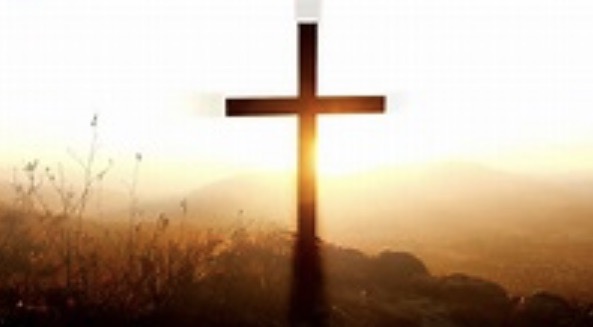
“The cross is one of the oldest and most universal of all symbols [for Christians]. It is, of course, the perfect symbol of Christ because of his sacrifice upon the cross. In a broader sense, however, the cross has become the mark or sign of the Christian religion, the emblem of atonement, and the symbol of salvation and redemption through Christianity…The crucifix is a representation of Christ on the cross.” 1
There are many variations of the cross, but the two chief ones are the Latin cross which shows a longer upright bar than the horizontal. The Greek cross shows both bars of equal length.
The cross is sometimes worn as an adornment of jewelry, but St. Paul wrote about it in a differently, wonder filled way. “For the word of the cross is folly to those who are perishing, but to us who are being saved it is the power of God.” 2
For Jesus followers the cross has deep and important significance. It was the place where Jesus paid the ultimate price for our sins. Crucifixion is a “method of capital punishment in which the victim is tied or nailed to a large wooden cross or beam and left to hang until eventual death…It was used as a punishment by the Persians, Carthaginians and Romans, among others. Crucifixion has been used in parts of the world as recently as the 21st century” 3 For Christians, scripture shares the meaning of Jesus’ violent death as an atonement (covering) for sins. The “Son of Man” was made “to be sin who knew no sin, so that in him we might become the righteousness of God.”4
A crucifix (from the Latin cruci fixus meaning ‘(one) fixed to a cross’) is a cross with an image of Jesus on it, as distinct from a bare cross. The representation of Jesus himself on the cross is referred to in English as the corpus (Latin for ‘body’)
There are many groups of Christians who use crucifixes in their churches (Roman Catholic, Eastern Orthodox, Lutherans, and Anglicans). The symbol demonstrates the cruel death Jesus died to provide redemption for all who believe and receive its truth. 3
It is a curiosity to Christian scholars why images of the cross or crucifixion did not appear in the early centuries after Christ’s departure. Some speculate that the early believers did not want to portray their Savior in so shocking a way. Others speculate that portraying Christ on a cross would actually profane the mystery of the Son of God.
Today, those of us who identify as Jesus followers view the cross or crucifix as a reminder of the complete cost to Jesus to secure forgiveness of sins. And Jesus willingly paid it. The sight of a cross or crucifix then is one of the most important symbols to Jesus followers, reminding us of the cost to Him, but also a reminder that each follower is called to take up his or her own cross and follow Him. “Indeed, I count everything as loss because of the surpassing worth of knowing Christ Jesus my Lord…that I may know him and the power of his resurrection, and may share his sufferings, becoming like him in his death, that by any means possible I may attain the resurrection from the dead.” (Philippians 3:8-11, ESV).
Rather than merely observing the symbol as a representation of some distant event, the cross/crucifix can serve as a reminder that to follow Jesus involves dying to self. A man who personified this in his life was Dietrich Bonhoeffer (4 February 1906 – 9 April 1945) a German Lutheran pastor, theologian and anti-Nazi dissident. He expressed his belief with these words: “Disciples will not be weakened by suffering, worn down, and embittered until they are broken. Instead, they bear suffering, by the power of him who supports them. The disciples bear the suffering laid on them only by the power of him who bears all suffering on the cross. As bearers of suffering, they stand in communion with the Crucified.” Bonhoeffer was martyred for his stand against Hitler shortly before the end of World War 2.
- “Signs and Symbols in Christian Art,” George Ferguson (p.164, 166)
- (1 Corinthians 1:18, ESV)
- (Wikipedia)
- (2 Corinthians 5:21, ESV)

 Rich Rockwood, Christian Author