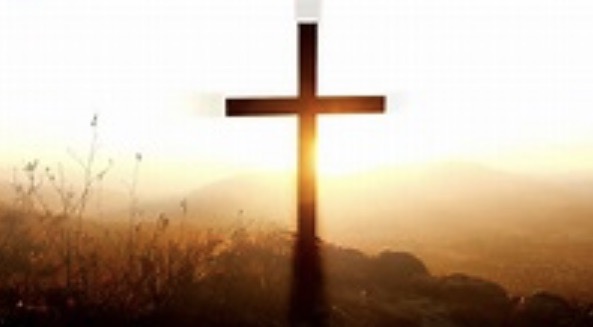
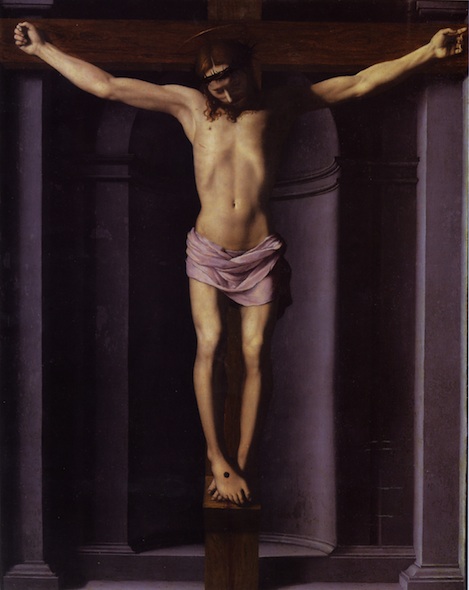
“The cross is one of the oldest and most universal of all symbols [for Christians]. It is, of course, the perfect symbol of Christ because of his sacrifice upon the cross. In a broader sense, however, the cross has become the mark or sign of the Christian religion, the emblem of atonement, and the symbol of salvation and redemption through Christianity…The crucifix is a representation of Christ on the cross.” 1
There are many variations of the cross, but the two chief ones are the Latin cross which shows a longer upright bar than the horizontal. The Greek cross shows both bars of equal length.
The cross is sometimes worn as an adornment of jewelry, but St. Paul wrote about it in a differently, wonder filled way. “For the word of the cross is folly to those who are perishing, but to us who are being saved it is the power of God.” 2
For Jesus followers the cross has deep and important significance. It was the place where Jesus paid the ultimate price for our sins. Crucifixion is a “method of capital punishment in which the victim is tied or nailed to a large wooden cross or beam and left to hang until eventual death…It was used as a punishment by the Persians, Carthaginians and Romans, among others. Crucifixion has been used in parts of the world as recently as the 21st century” 3 For Christians, scripture shares the meaning of Jesus’ violent death as an atonement (covering) for sins. The “Son of Man” was made “to be sin who knew no sin, so that in him we might become the righteousness of God.”4
A crucifix (from the Latin cruci fixus meaning ‘(one) fixed to a cross’) is a cross with an image of Jesus on it, as distinct from a bare cross. The representation of Jesus himself on the cross is referred to in English as the corpus (Latin for ‘body’)
There are many groups of Christians who use crucifixes in their churches (Roman Catholic, Eastern Orthodox, Lutherans, and Anglicans). The symbol demonstrates the cruel death Jesus died to provide redemption for all who believe and receive its truth. 3
It is a curiosity to Christian scholars why images of the cross or crucifixion did not appear in the early centuries after Christ’s departure. Some speculate that the early believers did not want to portray their Savior in so shocking a way. Others speculate that portraying Christ on a cross would actually profane the mystery of the Son of God.
Today, those of us who identify as Jesus followers view the cross or crucifix as a reminder of the complete cost to Jesus to secure forgiveness of sins. And Jesus willingly paid it. The sight of a cross or crucifix then is one of the most important symbols to Jesus followers, reminding us of the cost to Him, but also a reminder that each follower is called to take up his or her own cross and follow Him. “Indeed, I count everything as loss because of the surpassing worth of knowing Christ Jesus my Lord…that I may know him and the power of his resurrection, and may share his sufferings, becoming like him in his death, that by any means possible I may attain the resurrection from the dead.” (Philippians 3:8-11, ESV).
Rather than merely observing the symbol as a representation of some distant event, the cross/crucifix can serve as a reminder that to follow Jesus involves dying to self. A man who personified this in his life was Dietrich Bonhoeffer (4 February 1906 – 9 April 1945) a German Lutheran pastor, theologian and anti-Nazi dissident. He expressed his belief with these words: “Disciples will not be weakened by suffering, worn down, and embittered until they are broken. Instead, they bear suffering, by the power of him who supports them. The disciples bear the suffering laid on them only by the power of him who bears all suffering on the cross. As bearers of suffering, they stand in communion with the Crucified.” Bonhoeffer was martyred for his stand against Hitler shortly before the end of World War 2.
“Signs and Symbols in Christian Art,” George Ferguson (p.164, 166)
Why do Christians use lilies at Easter in their churches and even in their homes? As a minister, every Easter the front of our church held a number of Easter Lily’s in full bloom. They gave off a strong fragrance which, if I am honest, actually bothered my allergies. I still, however, appreciated their beauty but did not know of and appreciate their religious symbolism.
“Christianity’s most important holiday is rich in symbols, some secular, some religious, from the Easter bunny who brings treats and toys to children, to the Easter lily, a tall, stalky plant topped by graceful, trumpet-shaped blooms. But while the fragrant flower that fills churches and homes come Easter might seem simply a beautiful decoration welcoming springtime, over the course of its fascinating history it has come to feature a far deeper connotation. Today’s Easter lily meaning is most commonly tied to the Bible and even Jesus Christ himself.”
This same website also goes on to point to a closer connection to Jesus Christ. White Lilies embody purity, the trumpet shaped blooms seem to be horns announcing the good news of Christ’s resurrection. Also, the life cycle of an Easter Lily, which spends several years beneath the earth before coming into full blossom, is very much like Our Lord’s time in the ground after his crucifixion and then his bursting forth in absolute glory on Easter morning.
Lilies are mentioned a few times in the Bible
“My beloved is mine, and I am his; he grazes among the lilies.” (Song of Solomon 2:16, ESV)
“I will be like the dew to Israel; he shall blossom like the lily; he shall take root like the trees of Lebanon;” (Hosea 14:5)
In the Gospel according to Luke, Jesus refers to the beauty of lilies: “Consider the lilies, how they grow: they neither toil nor spin, yet I tell you, even Solomon in all his glory was not arrayed like one of these. But if God so clothes the grass, which is alive in the field today, and tomorrow is thrown into the oven, how much more will he clothe you, O you of little faith!” (Luke 12:27-28, ESV)
Beautiful lilies then are visible signs that Almighty God will take care of each of us. Are we not more valuable than a lily? Therefore, we need never worry about our future.
I invite the reader the next time he or she sees an Easter Lily to study the white purity of the flower, notice the trumpet shape announcing the resurrection of our Lord, and take in again the blessed hope of our own that comes to everyone who embraces Jesus as LORD and Savior. The Easter Lily is a physical reminder that death is not the end for anyone who believes and trusts in the LORD.
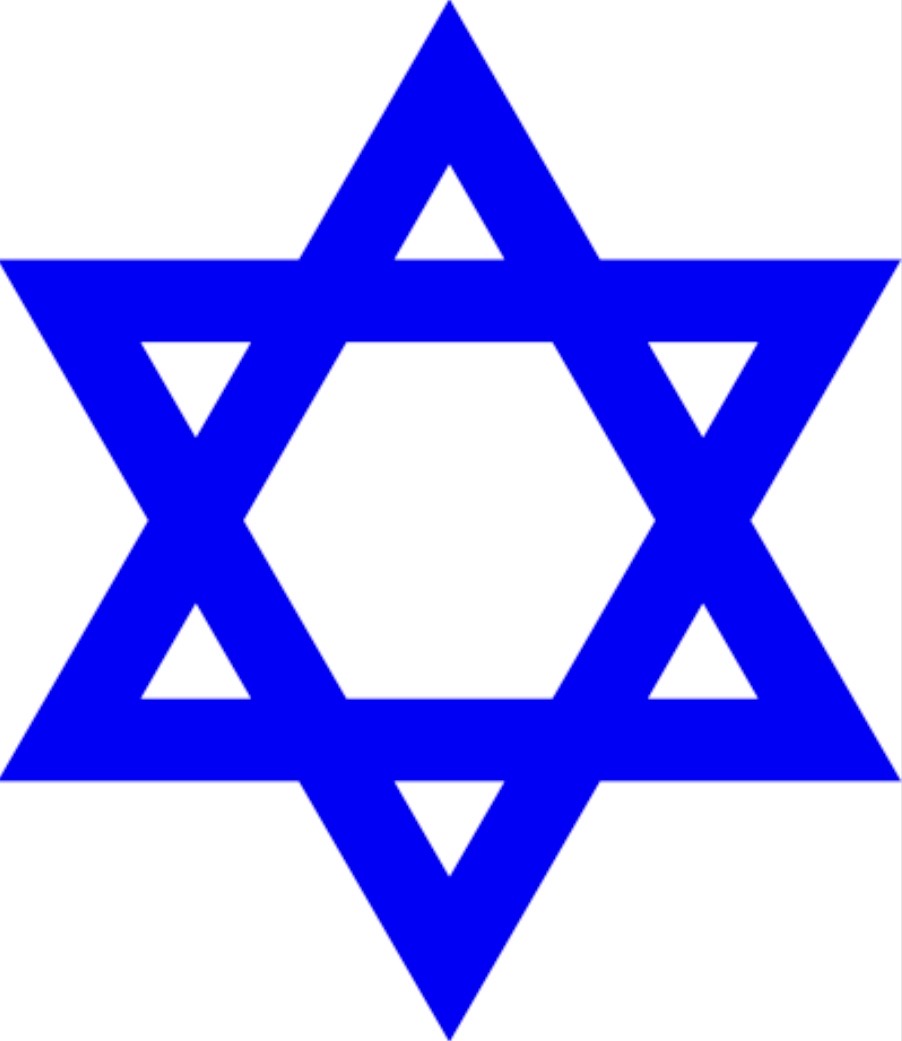
The six-pointed star is a symbol seen throughout the world since the beginning of history. It has had different names, depending on what religion or belief system it appears in.
In the book “Symbols: Signposts of Devotion,” Dr. Ratha Doyle McGee describes two main star symbols for Christians.
The first is called the Creator Star which consists of two equal sided triangles, one placed on top facing down on another facing up. The three sided angles represent the Trinity: Father, Son and Holy Spirit all present as a unity at the moment of creation.
The second is a five-pointed star which has a few different names: Star of Epiphany, Star of Jacob, Star of Jesse or the Star of Bethlehem. The Star of Epiphany is most often applied to this symbol. However, there is an interesting other possibility for this star. It is also sometimes a symbol for Mary, the mother of Jesus. The Hebrew version of the name Mary is Miriam which means star.
For Jews, the six-pointed star is the Star of David and appears on the flag of Israel. Consisting of two overlaid equal sided triangles, it is also called the “Shield of David.” In the Bible it was King David who united the tribes of Israel.
During the Holocaust of WWII, Jews were forced to wear the Star of David to identify themselves. If they failed to do this, they were punished. Some came to believe that this requirement for Jews actually strengthened the significance of the star, adding elements of martyrdom to its meaning.
For a Christian, looking at the star symbol can be a reminder that God has been, is now, and will forever be, intimately linked to His creation.
According to Apple Dictionary, a dove is “a stocky seed- or fruit-eating bird with a small head, short legs, and a cooing voice. Doves are generally smaller and more delicate than pigeons, but many kinds have been given both names.” Doves are mentioned in the Bible. It was a dove that brought an olive leaf in its mouth to Noah which told him the waters had gone down. In the Law of Moses, doves were declared to be pure and were used as an offering for the purification of a newborn child.
The International Bible Encyclopedia also notes: “Solomon uses the dove repeatedly in comparison or as a term of endearment. In Son 1:15; Son 4:1; Son 5:12, he compares the eyes of his bride full, tender, beautiful, with those of a dove. In Son 2:12 he uses the voice of the dove as an indication of spring. In Son 2:14 he addresses the bride as a rock dove, In Son 5:2 is another term of endearment, this time used in the dream of the bride (compare Son 6:9).”
Probably the most important use of the dove symbol is that of the Holy Spirit. In Jesus’en baptism, all four gospel accounts describe the descent of the Holy Spirit in the form of a dove that came down from heaven. For example: Mark 1:9-11 (English Standard Version) In those days Jesus came from Nazareth of Galilee and was baptized by John in the Jordan. [10] And when he came up out of the water, immediately he saw the heavens being torn open and the Spirit descending on him like a dove. [11] And a voice came from heaven, “You are my beloved Son; with you I am well pleased.”
As a represention of the Holy Spirit, a dove is meant to impart a sense of holy purity and innocence in the life of a believer. The Holy Spirit is the force of God gently drawing a person into loving experiences with Him. Each time we notice this symbol in church or in their home, it is there to a remind us of the path of purification and holiness God has placed every believer on.
The dove is an emblem of purity and harmlessness (Matthew 10:16), and the form of the dove at Jesus’ baptism signified that the Spirit in Jesus was one of holiness and innocence.
The dove is a great symbol of God’s grace in each believer’s life. The following poem, from https://www.christart.com expresses the gratitude of a man deeply aware of this truth. He put into words what we all may feel.
According to “Symbols: Signposts of Devotion,” by Dr. Ratha Doyle McGee, the connection between the symbol of fish and scriptures is “somewhat obscure.” It might connect to the story in Luke Chapter 24 where Jesus is eating a piece of fish after the resurrection. The author also points out “The fish was used as a method of conveying a message to another Christian without the message being understood by the Roman police.” Upon meeting another person, a Christian would draw a curved line in the sand and the other person, if a Christian, would draw another curved line opposite the first which made a rough outline of a fish. Thus each Christian could relax and talk freely about their faith.
Also, Dr. McGee wrote that each Greek letter in the word for fish (Icthus) could stand for a word in the sentence: Jesus Christ, Son of God, Savior.
Iota=Iesous or Jesus
Chi=Khristos or Anointed
Theou=of God
Uios=Son
Soter=Savior
So in this context, the word for fish in the original Greek, corresponded to the Church’s understanding of who Jesus of Nazareth actually is.
In the book “Understanding Early Christian Art,” Dr. Robin Margaret Jensen found in her research a connection so strong between the fish symbol and baptism, it “begins to become impossible to factor them out.” She goes on to point out “Beginning in the fourth century, western baptismal fonts were often called ‘fish ponds.’
The symbol of a fish has a strong background in Christianity which might be worth discovering again. It, like other symbols of our faith, is a meaning-filled representation of our commitment to and trust in Jesus Christ, Son of God, Savior.
In the 1970’s, in California, during the “Jesus Revolution” many Christians placed a small fish decal somewhere on their automobiles as a witness of their commitment to Christ. For some, the motivation for placing the decal on their car may have been from peer pressure. For others placing a fish on his/her car was a serious matter. From then on, he/she had to reflect Christ in their driving and in their life.
These days one might see an occasional car with a fish or the word Jesus lettered in a way to resemble a fish. If more Christians had fish decals on their cars, would that make a difference in our country and in our world? If interested, look online. There are Jesus/Fish decals available on eBay and Amazon to name a few.
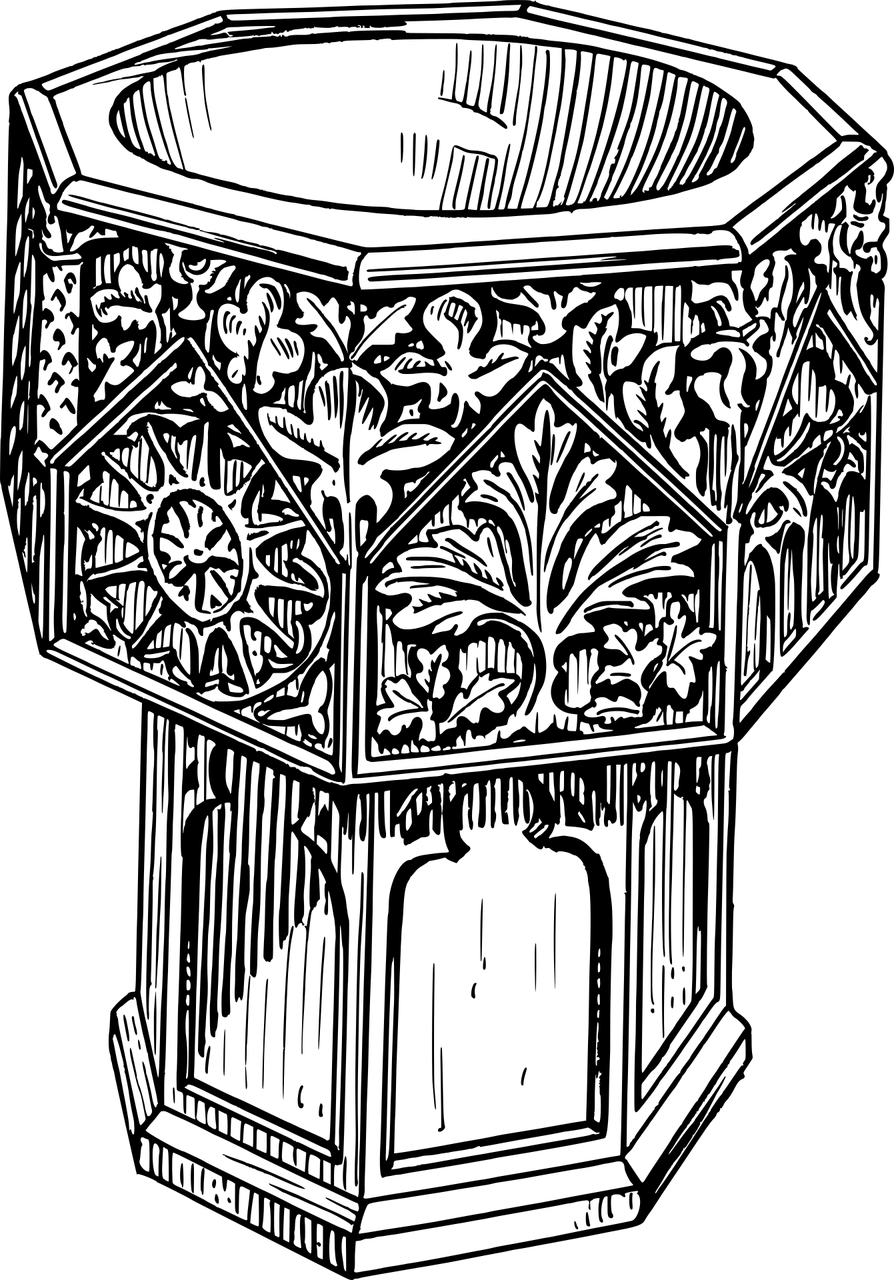
Water is a symbol of cleansing and purifying. In Christian baptism, water is used to signify a cleansing from sin. Also, in some denominations, it is a sign of the newness of life for a believer. The use of water in baptism varies widely. Some believers sprinkle the water from a baptismal fount, while others immerse the individual partially or even completely in a tank. Some believers use baptism of infants as a sign that the child is part of a special covenant (agreement) with God. Others believe that baptism is a sign of faith and so reserve it until the individual is able to acknowledge their faith before the church. Their baptism is an outward sign of an inward change.
While the New Testament proclaims baptism to be a sign of all believers’ unity in Christ, the meaning and practice of it has become a source for division. The apostle Paul wrote: Ephesians 4:4-6 (English Standard Version) “There is one body and one Spirit—just as you were called to the one hope that belongs to your call—one Lord, one faith, one baptism, one God and Father of all, who is over all and through all and in all.”And in another place, Paul wrote: Galatians 3:27-28 (ESV) “For as many of you as were baptized into Christ have put on Christ. There is neither Jew nor Greek, there is neither slave nor free, there is no male and female, for you are all one in Christ Jesus.”
Without dwelling on the differences about baptism’s meaning and practices, it is more useful to look at it’s promises. The baptism of a child or an adult is a sign and seal of God’s promises…to forgive our sins, to adopt us into the Body of Christ, the Church, and to send the Holy Spirit to renew and cleanse us and, in the future, bring that new life to completion in the eternity of Heaven.
The water in baptism is a visible sign of God promises.
The Anchor Bible Dictionary in looking specifically at the importance of baptism says “Such cleansings can take place on the verge of a new state in life or in entering into a community or upon a new phase of life”
So as water has the ability to cleanse a person or thing, likewise water in baptism signifies a purification of an individual who is entering a new phase in their life.
In the church I attend, there was an elder who has since passed away. Before the sacrament was administered on an adult or child this elder always scooped up a pitcher full of water and forcefully poured it into a bowl resulting in the water making loud splashing noises and spilling on to the floor. This was deliberately done to emphasize the overwhelming, cleansing grace of God given to the one being baptized.
With this reading, spend a few minutes to acknowledge that the water in each baptism is a beautiful sign of God’s promises over that life.
In the movie “Rome Adventure” the character played by Troy Donahue explains to the character played by Suzanne Pleshette, that the reason churches used art in the past was that most people could not read. Art was a a means of communicating biblical truths. Ironically today, many church goers who can read, may not understand and appreciate what they see portrayed in religious symbols, stained glass, or other forms of Christian art. One of the purposes of this current theme is to highlight the meaning behind a few important ones so we all can have a deeper spiritual appreciation of them.
So far we have looked at lit candles (symbol for Christ), cups (symbol of Christ’s accepting His oncoming death), anchors (symbol that faith in Christ is a source of stability for our life) and bread (symbol of the body of Christ).
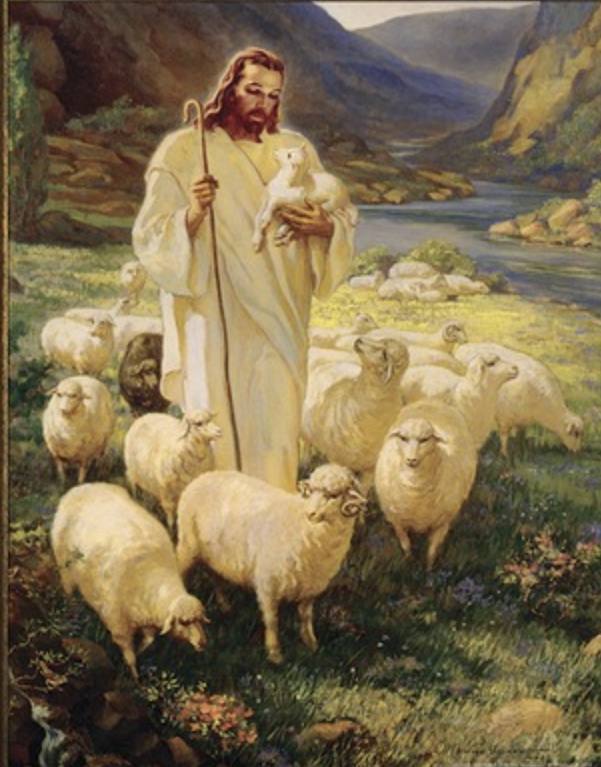
In this blog we are looking at the symbol of a shepherd. Christians refer to Jesus as the Good Shepherd because that’s how He characterized Himself: John 10:11-15 (ESV) “I am the good shepherd. The good shepherd lays down his life for the sheep.” Many leaders have devoted followers, but how many leaders would lay down their life for their loyal fans? Jesus contrasted himself to the hired hand who, when the wolf approaches, takes off. Jesus did not run away from the Cross, but gladly took it upon Himself and with it, the sins of the world.
In his commentary, Adam Clarke shows how a shepherd takes care of his sheep:
“God condescends to call himself the Shepherd of his people, and his followers are considered as a flock under his guidance and direction.
1. He leads them out and in, so that they find pasture and safety.
2. He knows where to feed them, and in the course of his grace and providence leads them in the way in which they should go.
3. He watches over them and keeps them from being destroyed by ravenous beasts.
4. If any have strayed, he brings them back.
5. He brings them to the shade in times of scorching heat; in times of persecution and affliction, he finds out an asylum for them.
6. He takes care that they shall lack no manner of thing that is good.”
In the church I pastored in New York State, there was a colorful, stained glass picture of the Good Shepherd holding a little lamb in His arms. One of the members of that church always sat so she could look at that picture during the service. It always reminded her of the special care and protection she had because of her faith. When we look at the truth behind the picture of a shepherd, it can also give us great comfort and assurance. We are not alone. God is walking beside you and me possibly even carrying us, to help each of us when we feel lost and unsure.
After reading this, I invite you to go back and look at the image of the Good Shepherd with the little sheep walking with Him. Imagine yourself as one of them and realize again, or for the first time, that He still desires to be your Good Shepherd.
According to Wikipedia “Bread is a staple food prepared from a dough of flour (usually wheat) and water, usually by baking. Throughout recorded history and around the world, it has been an important part of many cultures’ diet. It is one of the oldest human-made foods, having been of significance since the dawn of agriculture, and plays an essential role in both religious rituals and secular culture.”
In Judaism, for example, this prayer is to be said before a meal “Blessed art Thou, O Lord our God, King of the universe, who bringest forth bread from the earth.” In ancient times in the Temple as instructed, the Jews placed twelve loaves of bread, presumably one for each tribe, in the sanctuary before God’s face. These loaves were called the Bread of Presence, a reminder that God was always with them.
Easton’s Bible Dictionary points out that in the Bible “The word bread is used figuratively in such expressions as “bread of sorrows” (Ps 127:2, “bread of tears” Ps 127:2, i.e., sorrow and tears are like one’s daily bread, they form so great a part in life. The bread of “wickedness” (Prov 4:17) and “of deceit” Prov 20:17) denote in like manner that wickedness and deceit are a part of the daily life.”
For Christians bread plays a very important symbolic part. At the Last Supper, “…as they were eating, Jesus took bread, and after blessing it broke it and gave it to the disciples, and said, Take, eat; this is my body.'” (Matthew 26:26). With these words, Christ raised the symbolism of bread up to that of a representation of His own body which would be broken during his arrest, “trial”and execution. Realizing this, has given me a new appreciation of the presence of bread in worship. His body was broken that we might have union with God. Can you relate?
Since that time, in worship, Christians have shared bread in what is known as Communion.
So what is a staple in most diets has become for Christians an ultimate symbol of His atonement for sins and our union with Almighty God. It is celebrated in different ways and with different meanings. For some it is merely a reminder of Christ’s sacrifice, to others His presence is all around the bread and even within each piece.
According to Apple’s Dictionary, an anchor “is a heavy object attached to a rope or chain and used to moor a vessel to the sea bottom.. It can also be “a person or thing that provides stability or confidence in an otherwise uncertain situation.”
An anchor has been a sign of hope for Christians based on this verse in the Bible: Hebrews 6:19 (ESV) “We have this as a sure and steadfast anchor of the soul, a hope that enters into the inner place behind the curtain,” The symbol was depicted in many catacombs, ancient underground burial places because Christians did not agree with the pagan practice of cremating their dead. The anchor was also seen as a reminder of St. Clement who was condemned to death by being tossed into the sea fastened to an anchor.
Hope College, located in Holland Michigan, has used the anchor as its logo. The idea for this came from an observation by the founder of the city Rev. Albertus Van Raalte “This is my anchor of hope for this people in the future.” The college’s motto is “Spera in Deo” which translates “Hope in God.”
In Christianity, the church is often viewed as a ship, tossed about by wind and waves. In this context then, the anchor is what holds the ship in place against the buffeting forces of life. The anchor is God almighty. It is interesting that some have noticed the similarity between a few anchors (like the one pictured above) and the cross. For the believer, having hope based on Christ’s atoning death completes the picture. The English poet, Alfred Lord Tennyson wrote: “Cast all your cares on God; that anchor holds.”
A long time friend recently shared the article I’m including below. I wanted to pass it along.
As we approach this Easter Sunday, it’s easy to simplify the holiday with colored eggs, candy and family dinners. Perhaps we overlook Good Friday altogether, as if it were just a “speed bump” on they way to Sunday. Typically, Friday is occupied with gathering the goodies and planning Easter dinner.
We know Easter is a celebration of the Resurrection of Christ because that Sunday, two thousand years ago, a miracle above all miracles occurred as He rose.
This year, I will be thinking more about Good Friday because of the events of that day. Those events took place over at least 12 hours, and maybe longer. I wish to share with all of you a description of what happened on that particular Friday, as the Passover approached at sundown.
On that Friday, oh my goodness, that Friday! Our Lord and Savior fearfully, yet willingly, offered Himself up as payment for our sin. “For the wages of sin is death, but the gift of God is eternal life in Christ Jesus our Lord.” and on that day, the wages were paid in full. On the following Sunday, Death was conquered (“Oh death, where is thy sting, oh grave where is thy victory?”).
If we can get a full grasp of what actually occurred on that Friday when sin, guilt, and death were taken up on the cross, then Sunday might be as shocking and glorious today as it was to those who personally knew our lord and witnessed the events first hand.
Even though it’s quite long, I would encourage all of you to read the following with penetrating focus and attention, letting your emotions go where they will.
As the world celebrates they know not what, pause on Friday to reflect on the events of that day detailed below. May we all be in awe of God’s amazing grace beyond our traditional foods and activities.
======================================
A Physician’s View of the Crucifixion of Jesus Christ Dr. C. Truman Davis
Introduction About a decade ago, reading Jim Bishop’s The Day Christ Died, I realized that I had for years taken the Crucifixion more or less for granted — that I had grown callous to its horror by a too easy familiarity with the grim details and a too distant friendship with our Lord. It finally occurred to me that, though a physician, I didn’t even know the actual immediate cause of death. The Gospel writers don’t help us much on this point, because crucifixion and scourging were so common during their lifetime that they apparently considered a detailed description unnecessary.
So we have only the concise words of the Evangelists: “Pilate, having scourged Jesus, delivered Him to them to be crucified — and they crucified Him.” I have no competence to discuss the infinite psychic and spiritual suffering of the Incarnate God atoning for the sins of fallen man. But it seemed to me that as a physician I might pursue the physiological and anatomical aspects of our Lord’s passion in some detail.
What did the body of Jesus of Nazareth actually endure during those hours of torture?
The History of Crucifixions This led me first to a study of the practice of crucifixion itself; that is, torture and execution by fixation to a cross. I am indebted to many who have studied this subject in the past, and especially to a contemporary colleague, Dr. Pierre Barbet, a French surgeon who has done exhaustive historical and experimental research and has written extensively on the subject.
Apparently, the first known practice of crucifixion was by the Persians. Alexander and his generals brought it back to the Mediterranean world — to Egypt and to Carthage. The Romans apparently learned the practice from the Carthaginians and (as with almost everything the Romans did) rapidly developed a very high degree of efficiency and skill at it. A number of Roman authors (Livy, Cicer,Tacitus) comment on crucifixion, and several innovations, modifications, and variations are described in the ancient literature. For instance, the upright portion of the cross (or stipes) could have the cross-arm (or patibulum) attached two or three feet below its top in what we commonly think of as the Latin cross. The most common form used in our Lord’s day, however, was the Tau cross, shaped like our letter T. In this cross, the patibulum was placed in a notch at the top of the stipes. There is archeological evidence that it was on this type of cross that Jesus was crucified.
Without any historical or biblical proof, Medieval and Renaissance painters have given us our picture of Christ carrying the entire cross. But the upright post, or stipes, was generally fixed permanently in the ground at the site of execution and the condemned man was forced to carry the patibulum, weighing about 110 pounds, from the prison to the place of execution.
Many of the painters and most of the sculptors of crucifixion, also show the nails through the palms. Historical Roman accounts and experimental work have established that the nails were driven between the small bones of the wrists (radial and ulna) and not through the palms. Nails driven through the palms will strip out between the fingers when made to support the weight of the human body. The misconception may have come about through a misunderstanding of Jesus’ words to Thomas, “Observe my hands.” Anatomists, both modern and ancient, have always considered the wrist as part of the hand.
A titulus, or small sign, stating the victim’s crime was usually placed on a staff, carried at the front of the procession from the prison, and later nailed to the cross so that it extended above the head. This sign with its staff nailed to the top of the cross would have given it somewhat the characteristic form of the Latin cross.
The Agony in the Garden But, of course, the physical passion of the Christ began in Gethsemane. Of the many aspects of this initial suffering, the one of greatest physiological interest is the bloody sweat. It is interesting that St. Luke, the physician, is the only one to mention this. He says, “And being in agony, He prayed the longer. And His sweat became as drops of blood, trickling down upon the ground.” Every ruse (trick) imaginable has been used by modern scholars to explain away this description, apparently under the mistaken impression that this just doesn’t happen. A great deal of effort could have been saved had the doubters consulted the medical literature. Though very rare, the phenomenon of Hematidrosis, or bloody sweat, is well documented. Under great emotional stress of the kind our Lord suffered, tiny capillaries in the sweat glands can break, thus mixing blood with sweat. This process might well have produced marked weakness and possible shock.
His Court Appearances After the arrest in the middle of the night, Jesus was next brought before the Sanhedrin and Caiphus, the High Priest; it is here that the first physical trauma was inflicted. A soldier struck Jesus across the face for remaining silent when questioned by Caiphus. The palace guards then blind-folded Him and mockingly taunted Him to identify them as they each passed by, spat upon Him, and struck Him in the face.
In the early morning, battered and bruised, dehydrated, and exhausted from a sleepless night, Jesus is taken across the Praetorium of the Fortress Antonia, the seat of government of the Procurator of Judea, Pontius Pilate. You are, of course, familiar with Pilate’s action in attempting to pass responsibility to Herod Antipas, the Tetrarch of Judea. Jesus apparently suffered no physical mistreatment at the hands of Herod and was returned to Pilate.
It was then, in response to the cries of the mob, that Pilate ordered Bar-Abbas released and condemned Jesus to scourging and crucifixion. There is much disagreement among authorities about the unusual scourging as a prelude to crucifixion. Most Roman writers from this period do not associate the two. Many scholars believe that Pilate originally ordered Jesus scourged as his full punishment and that the death sentence by crucifixion came only in response to the taunt by the mob that the Procurator was not properly defending Caesar against this pretender who allegedly claimed to be the King of the Jews.
Preparations for the Scourging Preparations for the scourging were carried out when the Prisoner was stripped of His clothing and His hands tied to a post above His head. It is doubtful the Romans would have made any attempt to follow the Jewish law in this matter, but the Jews had an ancient law prohibiting more than forty lashes. The Roman legionnaire steps forward with the flagrum (or flagellum) in his hand. This is a short whip consisting of several heavy, leather thongs with two small balls of lead attached near the ends of each. The heavy whip is brought down with full force again and again across Jesus’ shoulders, back, and legs.
The Effects of the Scourging At first the thongs cut through the skin only. Then, as the blows continue, they cut deeper into the subcutaneous tissues, producing first an oozing of blood from the capillaries and veins of the skin, and finally spurting arterial bleeding from vessels in the underlying muscles. The small balls of lead first produce large, deep bruises which are broken open by subsequent blows. Finally the skin of the back is hanging in long ribbons and the entire area is an unrecognizable mass of torn, bleeding tissue. When it is determined by the centurion in charge that the prisoner is near death, the beating is finally stopped. The half-fainting Jesus is then untied and allowed to slump to the stone pavement, wet with His own blood.
The Roman soldiers see a great joke in this provincial Jew claiming to be king. They throw a robe across His shoulders and place a stick in His hand for a scepter. They still need a crown to make their travesty complete. Flexible branches covered with long thorns (commonly used in bundles for firewood) are plaited into the shape of a crown and this is pressed into His scalp. Again there is copious bleeding, the scalp being one of the most vascular areas of the body.
The Crowning with Thorns After mocking Him and striking Him across the face, the soldiers take the stick from His hand and strike Him across the head, driving the thorns deeper into His scalp. Finally, they tire of their sadistic sport and the robe is torn from His back. Already having adhered to the clots of blood and serum in the wounds, its removal causes excruciating pain just as in the careless removal of a surgical bandage, and almost as though He were again being whipped the wounds once more begin to bleed. In deference to Jewish custom, the Romans return His garments. The heavy patibulum of the cross is tied across His shoulders, and the procession of the condemned Christ, two thieves, and the execution detail of Roman soldiers headed by a centurion begins its slow journey along the Via Dolorosa.
The Journey to Golgotha In spite of His efforts to walk erect, the weight of the heavy wooden beam, together with the shock produced by copious blood loss, is too much. He stumbles and falls. The rough wood of the beam gouges into the lacerated skin and muscles of the shoulders. He tries to rise, but human muscles have been pushed beyond their endurance. The centurion, anxious to get on with the crucifixion, selects a stalwart North African onlooker, Simon of Cyrene, to carry the cross. Jesus follows, still bleeding and sweating the cold, clammy sweat of shock, until the 650 yard journey from the fortress Antonia to Golgotha is finally completed.
Nailed to a Cross Jesus is offered wine mixed with myrrh, a mild analgesic mixture. He refuses to drink. Simon is ordered to place the patibulum on the ground and Jesus quickly thrown backward with His shoulders against the wood. The legionnaire feels for the depression at the front of the wrist. He drives a heavy, square, wrought-iron nail through the wrist and deep into the wood. Quickly, he moves to the other side and repeats the action, being careful not to pull the arms too tightly, but to allow some flexion and movement. The patibulum is then lifted in place at the top of the stipes and the titulus reading, “Jesus of Nazareth, King of the Jews,” is nailed in place.
The left foot is now pressed backward against the right foot, and with both feet extended, toes down, a nail is driven through the arch of each, leaving the knees moderately flexed. The Victim is now crucified. As He slowly sags down with more weight on the nails in the wrists, excruciating pain shoots along the fingers and up the arms to explode in the brain the nails in the wrists are putting pressure on the median nerves.
As He pushes Himself upward to avoid this stretching torment, He places His full weight on the nail through His feet. Again there is the searing agony of the nail tearing through the nerves between the metatarsal bones of the feet. At this point, as the arms fatigue, great waves of cramps sweep over the muscles, knotting them in deep, relentless, throbbing pain. With these cramps comes the inability to push Himself upward. Hanging by his arms, the pectoral muscles are paralyzed and the intercostal muscles are unable to act. Air can be drawn into the lungs, but cannot be exhaled. Jesus fights to raise Himself in order to get even one short breath. Finally, carbon dioxide builds up in the lungs and in the blood stream and the cramps partially subside. Spasmodically, he is able to push Himself upward to exhale and bring in the life-giving oxygen.
While He Hung on the Cross It was undoubtedly during these periods that He uttered the seven short sentences recorded:
The first, looking down at the Roman soldiers throwing dice for His seamless garment, “Father, forgive them for they know not what they do.” The second, to the penitent thief, “Today thou shalt be with me in Paradise.” The third, looking down at the terrified, grief-stricken adolescent John — the beloved Apostle — he said, “Behold thy mother.” Then, looking to His mother Mary, “Woman behold thy son.” The fourth cry is from the beginning of the 22nd Psalm, “My God, my God, why has thou forsaken me?”
Jesus experienced hours of limitless pain, cycles of twisting, joint-rending cramps, intermittent partial asphyxiation, searing pain where tissue is torn from His lacerated back as He moves up and down against the rough timber. Then another agony begins — a terrible crushing pain deep in the chest as the pericardium slowly fills with serum and begins to compress the heart. One remembers again the 22nd Psalm, the 14th verse: “I am poured out like water, and all my bones are out of joint; my heart is like wax; it is melted in the midst of my bowels.” It is now almost over. The loss of tissue fluids has reached a critical level; the compressed heart is struggling to pump heavy, thick, sluggish blood into the tissue; the tortured lungs are making a frantic effort to gasp in small gulps of air.
The markedly dehydrated tissues send their flood of stimuli to the brain. Jesus gasps His fifth cry, “I thirst.” One remembers another verse from the prophetic 22nd Psalm: “My strength is dried up like a potsherd; and my tongue cleaveth to my jaws; and thou has brought me into the dust of death.” A sponge soaked in posca, the cheap, sour wine which is the staple drink of the Roman legionaries, is lifted to His lips. He apparently doesn’t take any of the liquid.
The body of Jesus is now in extremes, and He can feel the chill of death creeping through His tissues. This realization brings out His sixth words, possibly little more than a tortured whisper, “It is finished.” His mission of atonement has completed. Finally He can allow his body to die. With one last surge of strength, he once again presses His torn feet against the nail, straightens His legs, takes a deeper breath, and utters His seventh and last cry, “Father! Into thy hands I commit my spirit.”
After He was Dead The rest you know. In order that the Sabbath not be profaned, the Jews asked that the condemned men be dispatched and removed from the crosses. The common method of ending a crucifixion was by crurifracture, the breaking of the bones of the legs. This prevented the victim from pushing himself upward; thus the tension could not be relieved from the muscles of the chest and rapid suffocation occurred. The legs of the two thieves were broken, but when the soldiers came to Jesus they saw that this was unnecessary. Apparently, to make doubly sure of death, the legionnaire drove his lance through the fifth interspace between the ribs, upward through the pericardium and into the heart. The 34th verse of the 19th chapter of the Gospel according to St. John reports: “And immediately there came out blood and water.” That is, there was an escape of water fluid from the sac surrounding the heart, giving postmortem evidence that Our Lord died not the usual crucifixion death by suffocation, but of heart failure (a broken heart) due to shock and constriction of the heart by fluid in the pericardium.
Thus we have had our glimpse — including the medical evidence — of that epitome of evil which man has exhibited toward Man and toward God. It has been a terrible sight, and more than enough to leave us despondent and depressed. How grateful we can be that we have the great sequel in the infinite mercy of God toward man — at once the miracle of the atonement (at one ment) and the expectation of the triumphant Easter morning.